THE COMPLETE ARGUMENT
Begin with character.
Read Books I, II and III in sequence. The first lays the ground, the second develops the argument and the third turns it towards professional practice.
Start with Book I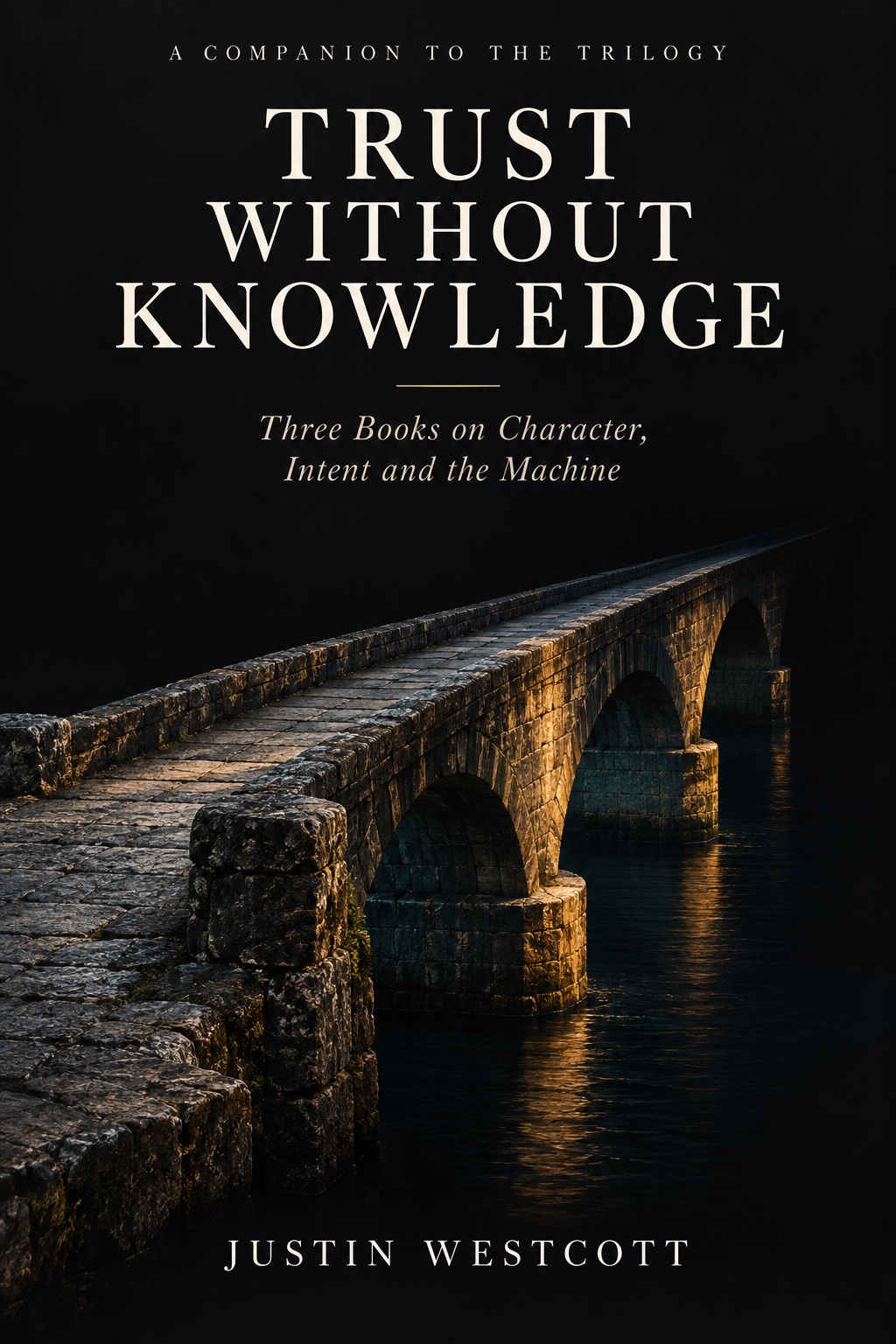
A COMPANION TO THE TRILOGY
Three Books on Character, Intent and the Machine
A guide to the trilogy's shared argument, showing how character, the limits of knowing intent and the protection of organisational memory fit together.
Release dates, editions and ordering details will be announced here. No orders are being taken through this website.
ONE CONTINUOUS ARGUMENT
The first book examines character. The second asks what we can know of another party's intent. The third follows the professional consequences. The companion maps the hand-offs, gathers the propositions and provides a shared vocabulary for reading the three together.
INSIDE THE COMPANION
Return to the argument without losing the connections.
The central question, the role of each volume and the ideas that travel between them.
A map of the argument, from the Greek account of character to the work of protecting an organisation that remembers.
The numbered claims brought together so that the argument can be followed across all three books.
A common vocabulary for disposition, evidence, intent, control and accumulated memory.
HOW TO READ THE TRILOGY
Read in order for the full argument, or begin with the practical problem that brought you here.
THE COMPLETE ARGUMENT
Read Books I, II and III in sequence. The first lays the ground, the second develops the argument and the third turns it towards professional practice.
Start with Book IFOR THE PRACTITIONER
Book III is written to support a reader starting there. Return to Books I and II for the accounts of character, evidence and control on which its programme rests.
Start with Book IIIKEEP THE THREAD
Use the shared glossary, overview and proposition list alongside the books, then return to them when tracing an idea across the trilogy.
See the three movementsTHE TRILOGY AT A GLANCE
The ground: character and the person.
The argument: the limits of knowing intent.
The programme: protecting organisational memory.
EVERY INQUIRY BEGINS SOMEWHERE