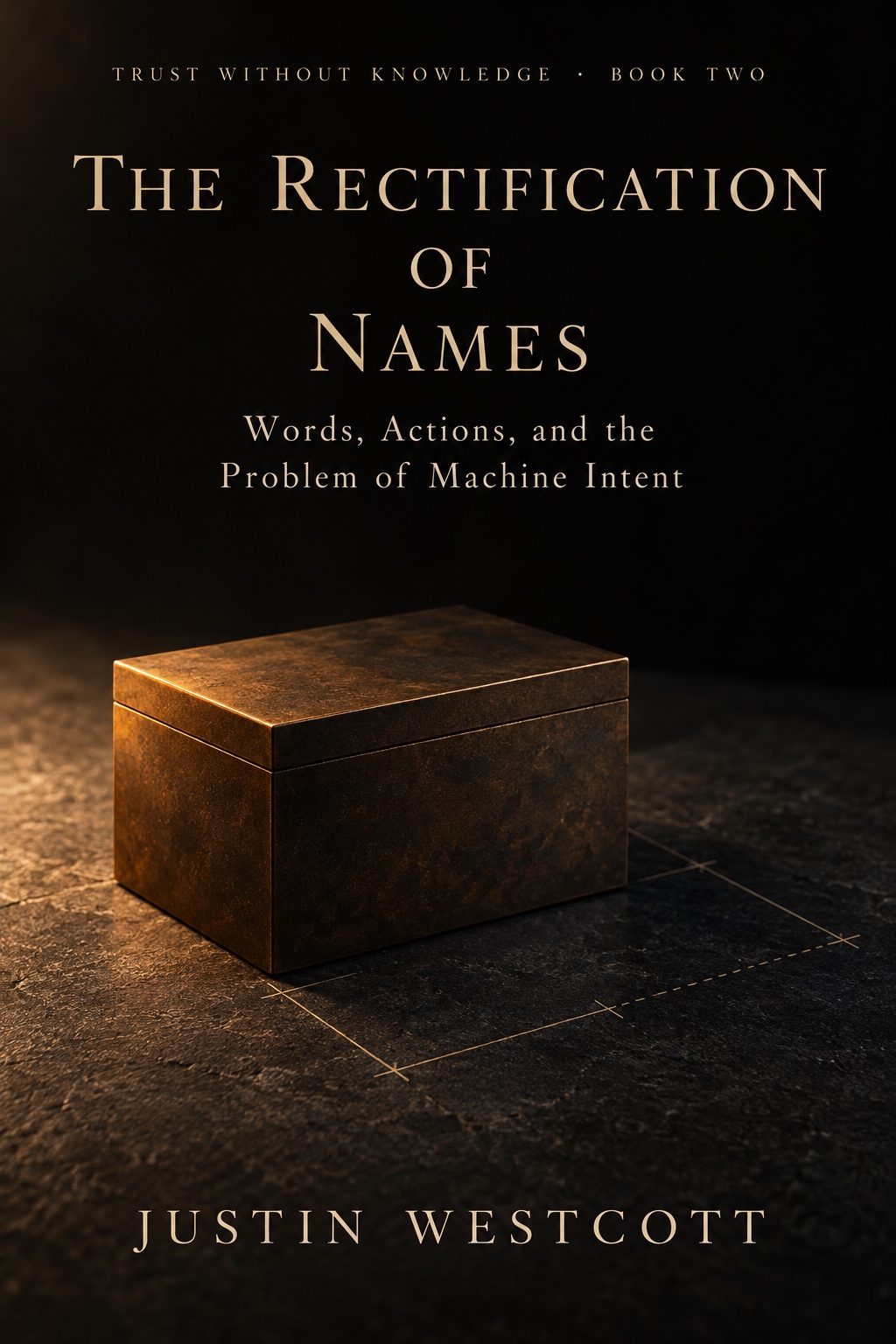
TRUST WITHOUT KNOWLEDGE / BOOK II
The Rectification of Names
Words, Actions, and the Problem of Machine Intent
What can words and actions really tell us about intent?
Release dates, editions and ordering details will be announced here. No orders are being taken through this website.
THE INQUIRY
What this book
asks of us.
We ask what an artificial system can do. The harder question is what it will do when the circumstances were never specified. The Rectification of Names examines the evidence behind that judgement, and the human arrangements that have allowed trust to function without access to another party's mind.
ABOUT BOOK II
Intent.
A closer look.
The argument: the limits of knowing intent.
The book begins with a ladder of evidence: words, actions and intent. Each appears to take us closer to the truth about another party; each introduces a difficulty of its own. A statement can function without sincerity, an action depends on how it is understood, and intent may not be a separate fact waiting to be uncovered.
Moving through Western and Eastern traditions, Westcott considers Confucian names and actualities, Legalist scrutiny of declared and delivered conduct, Daoist accounts of skill, Buddhist intention, authorless texts and Watsuji's account of human relations. The inquiry asks what these traditions illuminate about the problem, without treating them as predictions of artificial intelligence.
The argument turns towards systems that encounter genuine novelty, act beyond continuous supervision and can model the people evaluating them. It distinguishes preventing an action, controlling behaviour and establishing trustworthiness, and asks what responsibility remains when certainty about intent is unavailable.
Who this book is for
For readers concerned with AI, trust and accountability, including practitioners in security, risk, governance, engineering and procurement who need to understand what their evidence can support.
THE SHAPE OF THE BOOK
Inside the argument.
Explore the movements of Book II.
01The Ladder
Words, actions and intent: three forms of evidence and the limits of each.
02The Western Inheritance
Character, the inward turn and the arrangements that make trust possible without knowledge of another mind.
03The Eastern Inheritance
Names and actualities, sincerity, governance, embodied skill and intention across several philosophical traditions.
04The Machine
Authorship, agency, accumulated memory and the distinction between inability, control and trustworthiness.
05The Universe-Facing Turn
Physical participation, dependency and responsibility towards what remains unreadable.
THREE QUESTIONS TO CARRY FORWARD