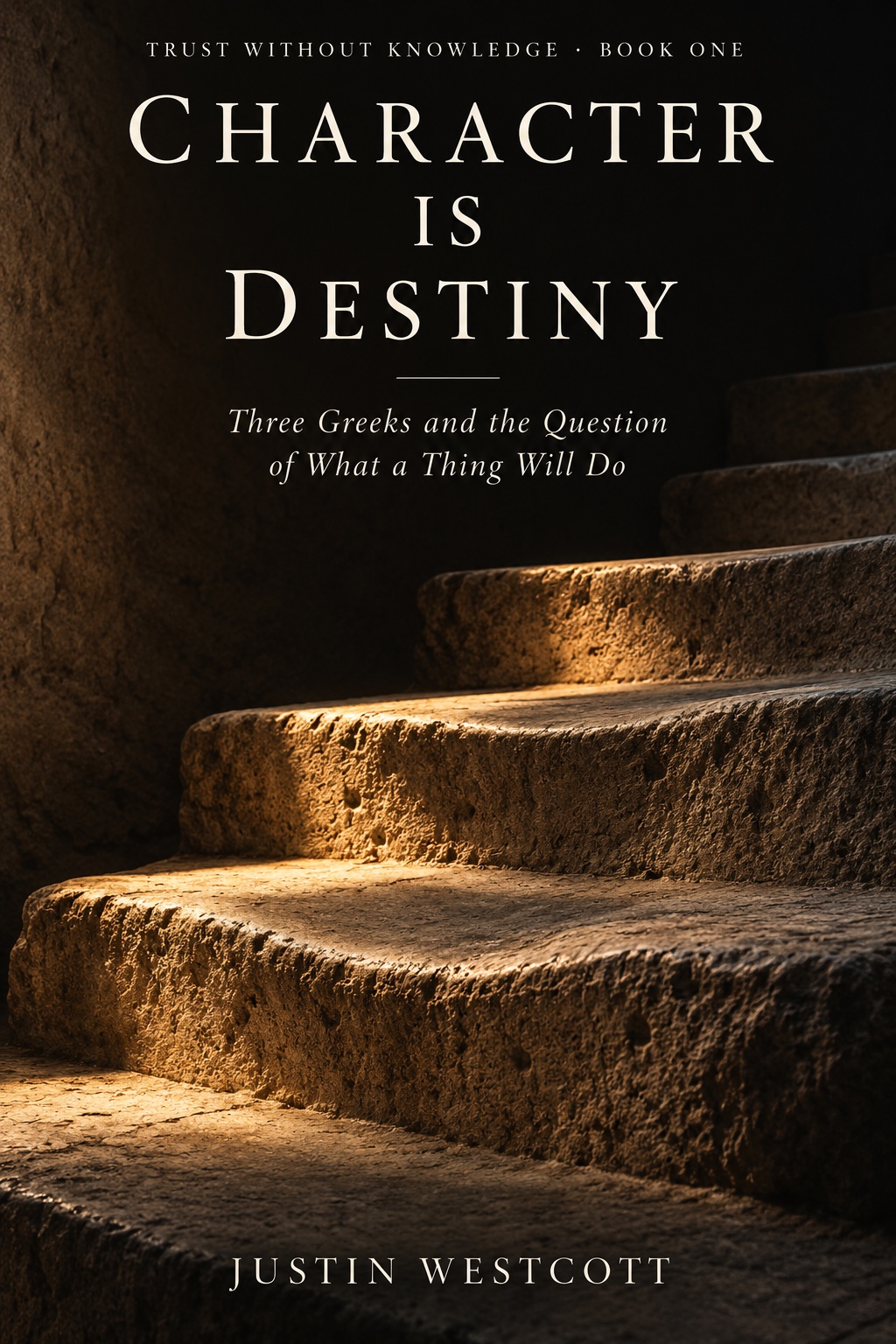
TRUST WITHOUT KNOWLEDGE / BOOK I
Character Is Destiny
Three Greeks and the Question of What a Thing Will Do
What does character reveal before a decision is made?
Release dates, editions and ordering details will be announced here. No orders are being taken through this website.
THE INQUIRY
What this book
asks of us.
A checklist can establish the state of an aircraft. It cannot establish what its pilot will do when the situation falls outside the manual. Character Is Destiny begins in that gap, and follows Socrates, Plato and Aristotle into the question of how a person becomes someone we can trust.
ABOUT BOOK I
Character.
A closer look.
The ground: character and the person.
A person's account of themselves, their conduct and the character behind that conduct are different kinds of evidence. Through Socratic examination, Plato's account of the ordered soul and Aristotle's understanding of habit, the book asks what each can actually tell us. Character emerges as something formed through repeated action, rather than established by declaration.
At its centre is practical judgement: the ability to act well when the circumstances are new and a rule cannot finish the decision. Drawing on experience in aviation and cybersecurity, Westcott asks how that judgement develops, how it is recognised and what remains beyond an observer's reach.
The opening volume supplies the trilogy's ground. Before asking whether a machine can be trusted, it examines what we have meant by trusting a person, and why the decisive fact so often seems to sit somewhere we cannot inspect.
Who this book is for
For readers interested in ethics, leadership and professional judgement, especially those who must rely on people in situations a procedure cannot fully specify.
THE SHAPE OF THE BOOK
Inside the argument.
Explore the movements of Book I.
01Words
Socrates, self-examination and the distance between what a person says and what they understand.
02Actions
Plato and Aristotle on conduct, settled character, responsibility and judgement where no rule reaches.
03The Good
Purpose, what lies within our power, the tradition's limits and what its argument hands to the next book.
THREE QUESTIONS TO CARRY FORWARD